
Zero Fees to Hire ・ 5,000+ Vetted Executives ・  US / UK / EU / AU

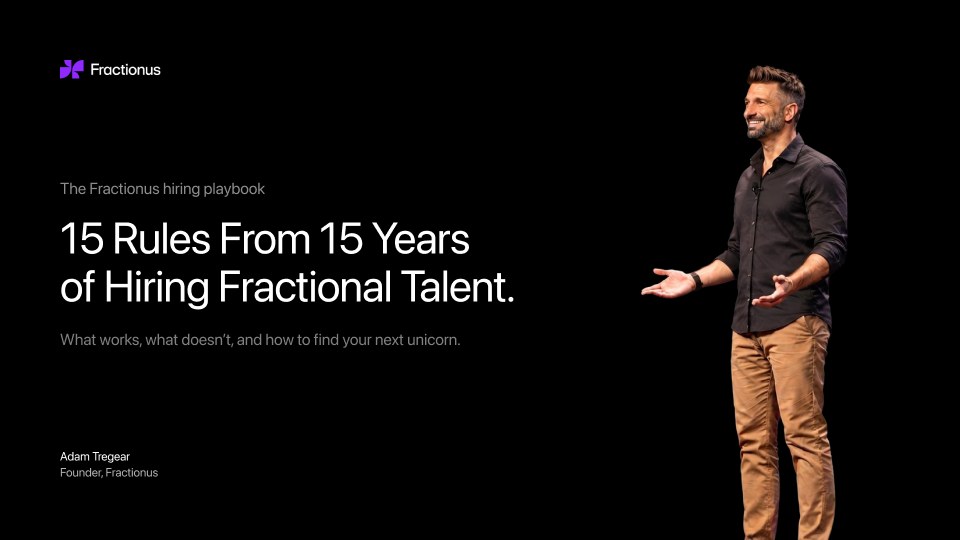
The Fractionus hiring playbook

15 Rules From 15 Yearsof Hiring Fractional Talent.

What works, what doesn’t, and how to find your next unicorn.

Adam Tregear
Founder, Fractionus
Adam Tregear, founder of Fractionus, speaking on stage
Adam Tregear smiling on stage

Introduction

I’m an operator,not a recruiter.

I’ve spent 15 years hiring people to help build and run businesses. I’ve filled seats I didn’t need, ignored doubts I should have listened to, and hired people so good I had to stretch to afford them. Through Fractionus, I’ve interviewed and placed hundreds more.

These are the rules I’d give anyone hiring fractional talent. They’re based on what I’ve learned from working with people after the interview is over.

Adam Tregear
Founder, Fractionus
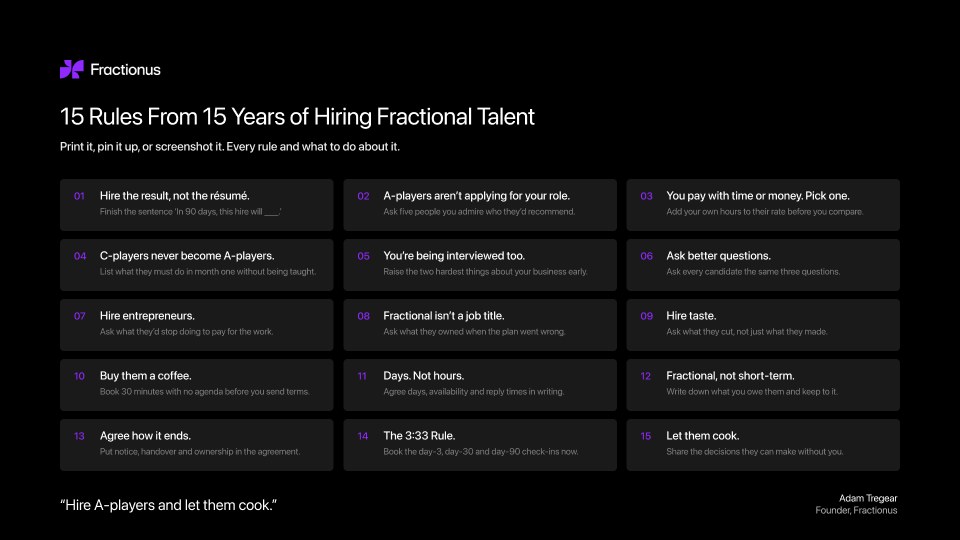
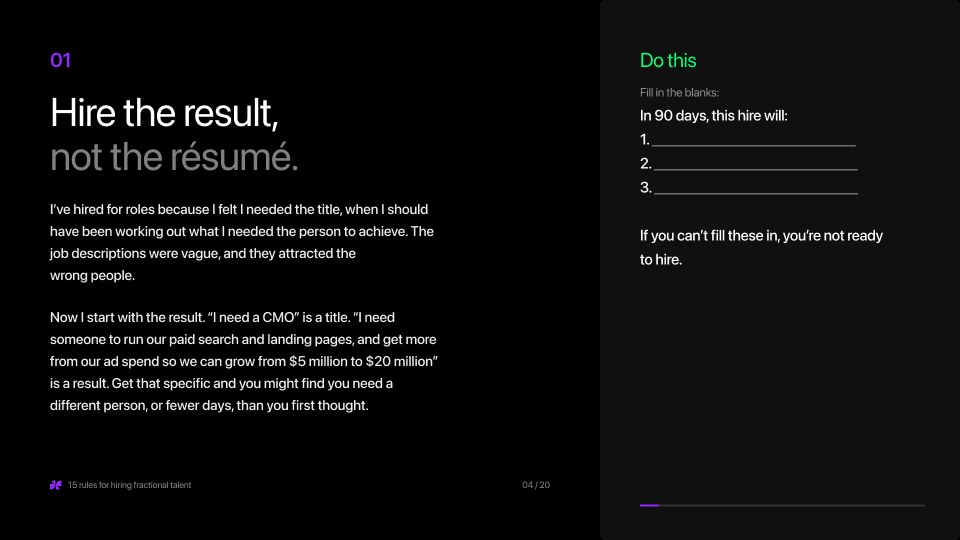
01

Hire the result,not the résumé.

I’ve hired for roles because I felt I needed the title, when I should have been working out what I needed the person to achieve. The job descriptions were vague, and they attracted the wrong people.

Now I start with the result. “I need a CMO” is a title. “I need someone to run our paid search and landing pages, and get more from our ad spend so we can grow from $5 million to $20 million” is a result. Get that specific and you might find you need a different person, or fewer days, than you first thought.

Do this

Fill in the blanks. In 90 days, this hire will:

1. ______________________

2. ______________________

3. ______________________

If you can’t fill these in, you’re not ready to hire.
02

A-players aren’tapplying for your role.

Some of the people you’d most like to hire aren’t looking for a full-time job. They’ve got clients, their own business or work they don’t want to give up. Your job ad won’t reach them, however good the salary looks.

A fractional role gives them another reason to consider you. It gives you access to experience you may not need, or be able to afford, five days a week. You’re paying for fewer days at their level. The rate still needs to respect their experience, and the workload needs to fit the days.

Do this

List five people whose work you admire who aren’t looking for a job. Ask each of them who they’d recommend for this outcome, or whether they’d consider a day a week themselves.

03

You pay with time or money.Pick one.

Some of my best hires cost more than I wanted to spend. I felt uncomfortable with the price, but I could see they understood the business and would make things happen. I found a way to make it work.

Other people looked affordable until I counted the time I spent directing them, chasing them and checking their work. Your time belongs in the calculation. If the cheaper person needs you beside them to keep things moving, you’re paying twice. Work out what you can afford, including how much of yourself the hire will need.

Do this

For your top two candidates, estimate the hours a week you’d spend directing each one. Put a value on your time and add it to their rate before you compare.

04

C-players neverbecome A-players.

People can improve. I’ve helped people improve. But I’ve also spent a lot of time getting someone to a reasonable standard, then had to keep doing that work to stop them slipping back.

When I hire experienced fractional talent, I’m paying for someone who can already operate at the level I need. I’m not buying a development project. They should keep learning, but I shouldn’t have to teach them how to take responsibility for the role.

My lesson is simple: don’t hire a C-player on the assumption you’ll turn them into an A-player.

Do this

Write down three things this person should be doing in month one without being taught. Use the list in every interview.

05

You’re beinginterviewed too.

The strongest people I’ve hired wanted to know whether we were right for them. They had questions about what we were building, how we worked and whether they’d have the freedom to do a good job.

Make room for those questions. Tell them what’s difficult about the business as well as what’s exciting. Explain what you need and listen to what they need from you. Good talent has choices. A first conversation should help both of you decide whether you want another one. You haven’t made a successful hire just because someone says yes.

Do this

Before the first call, write down the two hardest things about working in your business. Raise them yourself, early in the conversation.

06

Ask betterquestions.

Most interviews are a CV read back to you. One good question tells me more than an hour of rehearsed answers.

Ask questions they can’t prepare for. “If you were in my seat, what would you do first?” shows whether they bring a plan. “What would you stop doing to pay for this?” shows whether they think commercially. “What did you cut?” shows their taste. The answers they haven’t rehearsed are the ones that matter.

Do this

Write three questions they can’t prepare for. Ask every candidate the same three and compare the answers.

07

Hireentrepreneurs.

A fractional leader is running a business of one. Their income depends on the value they create for clients like you, so they should understand what an outcome is worth.

I look for someone who talks about the work in commercial terms. What will this cost? What will it return? What should we stop doing to pay for it? They know when a request goes beyond what we agreed, and they’ll tell me what it would take. You don’t need a former founder on the CV. You need someone who thinks about your business the way you do.

Do this

Ask ‘What would you stop doing to pay for this?’ Listen for whether the answer is in commercial terms.

08

Fractional isn’ta job title.

Putting ‘fractional’ in a profile doesn’t tell you how someone works. If you’re hiring a leader, you need to find out whether they’ll own the function or wait for a list of tasks.

Ask them to explain an engagement. What were they responsible for? Which decisions did they make? What happened when the plan went wrong? Freelance delivery has its place, and plenty of freelancers take real ownership. The problem is buying leadership and getting task execution. Be clear about which one you need before you agree on the price.

Do this

Ask them to walk you through one engagement: what they owned, one decision they made and what they did when the plan went wrong.

09

Hiretaste.

Taste matters in a leader. AI makes it easy to produce more. Someone still has to decide what’s worth keeping.

Can they recognise good work and explain why it’s good? Can they tell you what to leave out? I listen for that when they talk about past work and decisions. What did they choose, what did they reject, and why?

You’re going to trust their judgment when you aren’t in the room. Find out whether they have judgment you’d want to trust.

Do this

Ask to see one piece of work they’re proud of, then ask what they cut from it. The second answer tells you more.

10

Buy thema coffee.

Get to know the person you’re thinking of working with, beyond the CV and the interview answers. Call it a vibe check. Would you enjoy a hard Tuesday with this person? Do they get your sense of humour? Do they ask about you too?

Do it before you agree terms. You’ll be working closely with this person, often on the hard stuff, and an interview won’t tell you how that feels. Keep it about fit. Let them decide how much of their personal life to share.

Do this

Before you send terms, book 30 minutes with no agenda. No CV, no role questions.

11

Days.Not hours.

When I bring on fractional talent, we agree on days per week. That’s the commitment, not a timetable. Half a day on Tuesday and half on Thursday is fine. So are early mornings or late nights. How and when they do the work is up to them.

What I never ask is how many hours they did today. It’s the wrong question. A day might take four hours one week and ten the next, depending on what the outcome needs. Count hours and you end up managing effort. Agree on days and you stay focused on results.

Two things make this work. First, agree on when they’re reachable: which meetings they’ll join and how quickly they’ll reply. Second, size the work to the days. If the outcomes keep needing more time than you agreed, raise it early. Either the scope changes or the days do. And respect the limit yourself. If I haven’t paid for more time, I shouldn’t expect someone to quietly give it to me.

Do this

Agree three things in writing: days per week, when they’re reachable and how quickly they’ll reply.

12

Fractional,not short-term.

I treat every fractional hire like a long-term relationship, because that’s when the best results happen. Treat it like a quick fix and you’ll never get what you were really looking for. There are freelancers for that.

Loyalty has to be earned on both sides. If I say you’ll be paid on the fourteenth, you’re paid on the fourteenth. The same goes for decisions, communication and the days we’ve agreed. Keep your word, and if something changes, say so early. Fractional doesn’t mean someone owes you unpaid time. It means you both commit to the long game.

Do this

Write down what you owe them: the payment date, the decisions they’ll need from you and the access they need on day one. Hold yourself to it.

13

Agreehow it ends.

Before anyone starts, I want to know what happens if it stops working. How much notice does each side give? What gets handed over, and to whom? Who keeps the work, the files and the logins?

Nobody wants to talk about the end when everyone’s excited about the start. I’d still rather have that conversation then than when things are going badly. Agreeing the exit early lets us both commit properly. And if it does end, it stays a business conversation instead of a personal one.

Do this

Put three things in the agreement: the notice period for each side, what gets handed over, and who owns the work and the logins.

14

The 3:33 Rule.Three days. Thirty days. Three months.

That’s the rhythm I use to work out whether an engagement is going somewhere.

The first three working days show me habits: do they turn up, follow through and communicate? The first 30 days give us agreed outcomes to review together. Then we use what we’ve learned to plan the next three months and see the results develop.

You won’t judge a business transformation in three days. You can judge whether someone is doing what they said they would. Use each stage to answer the question it can realistically answer.

Do this

Book these before they start:

Day 3 — ______________________

Day 30 — ______________________

Day 90 — ______________________

15

Let themcook.

You’ve hired someone for their expertise. Give them the room to use it. If every decision has to come back through you, you’ll struggle to get the value you hired them for.

Agree on the outcome, the authority they have and when you’ll review progress. Give them the access and decisions they need from you. Then let them get on with it. You can stay involved without standing over them. The best people I’ve hired wanted autonomy and cared about the result. My job was to give them a business where they could do good work.

Do this

List the decisions they can make without you and share it in week one.

Unlock all 15 rules

Get the other 12 rulesand the PDF playbook.

Free, straight to your inbox. Every rule comes with one thing to do, plus a one-page summary you can print.

Thank you! Your submission has been received!
Oops! Something went wrong while submitting the form.
No spam. Unsubscribe anytime.
15 Rules From 15 Years of Hiring Fractional Talent playbook pages
Take it with you

Get the PDF and the one-page cheat sheet.

All 15 rules, every action, and a summary you can print and pin up.

Download the PDF

Need help?Let’s find your unicorn.

Tell us what needs to change in your business and we’ll help you work out who can own it. At Fractionus, we interview every candidate before we introduce them, so your first conversation is with someone worth meeting.

If you’re unsure who you need, let’s work it out together.

Adam Tregear on stage
Zero fees
100% free search & placement
Under 3% acceptance
Senior leaders only
5,000+ leaders
Across every function
“Hire A-players and let them cook.”
Adam Tregear